French Knots: Step-by-Step Guide for Flower Centers and Buds
How to make a French knot that stays on the surface: wrap twice, hold the thread taut and go down beside the starting point. Includes sizing and fixes.
Tutorial at a glance
Materials
- Six-strand cotton embroidery floss in one or two colors
- Embroidery needle size 7 or 8
- Water-soluble pen
- 6 in (15 cm) hoop
- Small embroidery scissors
A French knot is a short coil of thread, wrapped around the needle once or twice and pinned to the fabric by the same thread passing down through its middle. The result is a firm, raised dot. Nearly every problem with it traces back to two details: the wraps go slack while the needle is on its way down, or the needle goes back into the exact hole it came out of. Keep the thread taut and move the needle over by a thread or two of fabric, and the knot forms reliably.
Setting Up: Thread, Needle and Two Free Hands
Use two strands of six-strand cotton embroidery floss on an embroidery needle size 7 or 8 for a medium knot. The needle matters more here than in most stitches. Its eye has to pass through the wraps, so a needle with a bulky eye, or one that is too thick for the thread, will jam. If the needle sticks every time, go one size finer.
The stitch takes both hands: one holds the needle, the other holds the working thread under tension. That means the hoop has to stay put without being held. Rest its far edge on a table and its near edge against your body, or lay it flat on the table and lift only the edge. The fabric needs to be drum-tight so the needle can go straight down without pushing a dent into it.
French Knot, Step by Step
- Come up where the knot will sit. Pull the thread fully through to the front.
- Hold the thread. With your other hand, pinch the working thread about 2 inches (5 cm) from the fabric and hold it out to the side, taut.
- Wrap twice. Lay the needle against the taut thread and wind the thread around it two times. Keep the wraps close to the tip and next to each other, not crossed. Panel 1 shows the two wraps on the needle.
- Go down beside the starting point. Still holding the thread, turn the needle tip to the fabric and insert it right next to where the thread came up, one or two fabric threads away, as in panel 2. Do not use the same hole.
- Slide the wraps down. Before pushing the needle through, pull gently on the held thread so the wraps tighten around the needle and slide down to rest on the fabric.
- Pull through slowly. Push the needle to the back and draw the thread through, letting it run through the fingers of the holding hand until the last small loop disappears into the knot. Panel 3 shows the finished knot.

Changing the Size: Wraps Versus Strands
There are two ways to make a knot bigger, and they behave differently. Adding wraps makes the coil taller, and beyond two wraps it tends to topple sideways into a loose, lopsided loop. Adding strands makes the whole knot wider and rounder while it stays stable. So choose one wrap or two, then change the number of strands to get the size you need. The diagram shows three knots, each with two wraps, in one, two and three strands.

| Strands | Wraps | Needle size | Use |
|---|---|---|---|
| 1 | 2 | 8 or 9 | Stamen tips, pollen dots, tiny fillers |
| 2 | 1 | 7 or 8 | Flat, seed-like texture |
| 2 | 2 | 7 or 8 | Centers of small flowers |
| 3 | 2 | 7 | Buds, berries, bold centers |
| 6 | 1 | 5 | Large single dots on sturdy fabric |
Strands that have been separated one at a time and put back together make a plumper knot than strands pulled off the skein as a group; the thread guide explains the method.
The Usual Failures and Their Fixes
- The knot pulls through to the back. The needle went down the same hole it came up. Go down a thread or two away so a bridge of fabric holds the knot. On a loose weave, move over slightly farther.
- A loose loop sits on top of the knot. The held thread was released too early. Keep it taut until only a tiny loop is left, then let that loop slip into the knot.
- The knot is a tangle instead of a dot. The wraps crossed over each other, or the thread was wound three or four times. Wind twice at most, side by side.
- The needle will not pass through the wraps. They were tightened too hard against the needle. Ease the held thread a little; the wraps should be snug, not strangling.
- The knot stands on a little stalk. The wraps were not slid down to the fabric before pulling through. Push them down with a fingernail next time.
Watch out
A bad French knot cannot be unpicked neatly. Snip it off flush with small scissors on the front, pull the tail to the back, secure it under nearby stitches and make a new knot.
Flower Centers, Buds and Fillers
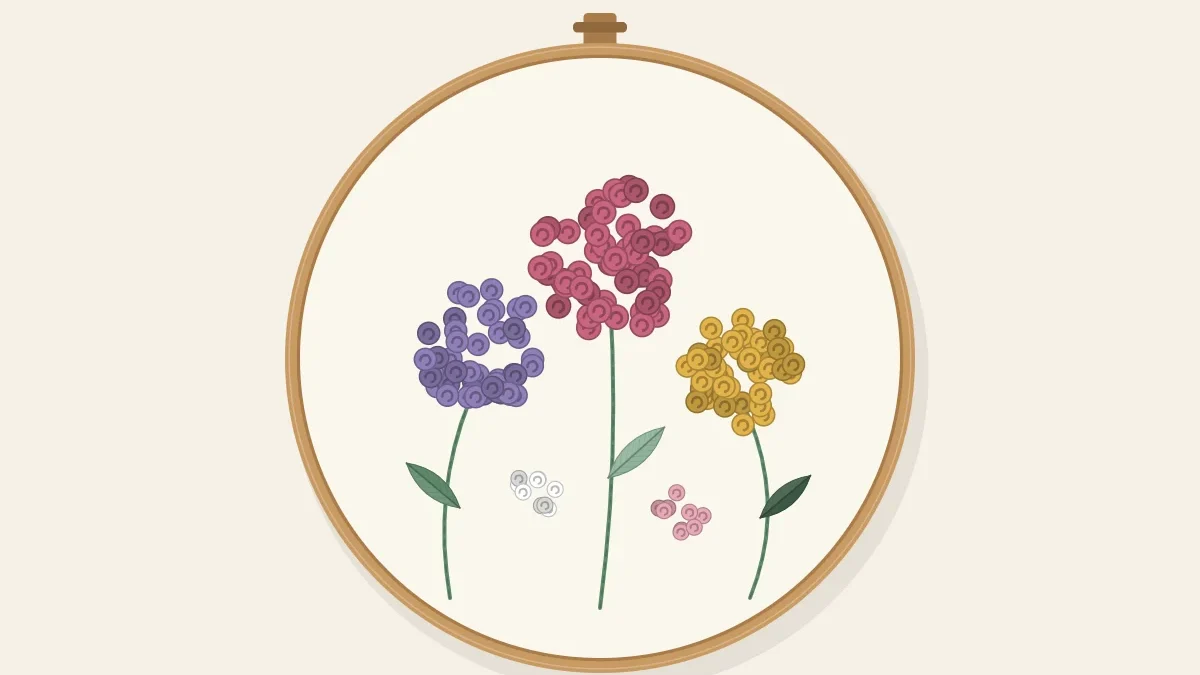
For a flower center, begin with one knot in the middle and add a ring around it, each knot touching its neighbors. A center 1/4 inch (6 mm) across takes about seven two-strand knots. Mixing two close shades, such as a yellow and a deeper gold, gives the cluster depth. A ring of lazy daisy stitch petals with three knots in the gap is one of the quickest finished flowers there is, while the packed center of the easy embroidered sunflower shows how dozens of knots fill a large area.
For buds, work single three-strand knots at the ends of fine stems, or two side by side for a bud that is starting to open. As a filler, scatter one-strand knots in the spaces between larger flowers, spaced unevenly so they look like tiny blossoms and not a dotted pattern.
Spacing on the back matters as well. Carry the thread from knot to knot only when they are less than 1/2 inch (12 mm) apart. For isolated knots, fasten off behind each one, because a long thread carried across the back can show through pale fabric and pulls the knots when the piece is stretched.
Once the French knot is comfortable, its longer relative is a natural next step. A bullion knot uses the same idea with many more wraps laid sideways along the fabric, and the bullion knot rose tutorial builds a whole flower from it.
Frequently asked questions
Does it matter which way I wrap the thread around the needle?
Not for the look of the knot. Wrap in whichever direction feels natural, and use the same direction each time so your knots match.
Should French knots be stitched first or last?
Last. They are raised, so the working thread catches on them, and a hoop moved over finished knots can flatten them.
Is a colonial knot the same thing?
No. A colonial knot is wrapped in a figure-eight instead of a plain coil. It looks similar and sits slightly higher, and many stitchers use the two interchangeably.
Will French knots come undone in the wash?
A knot that was pulled snug and has its thread secured on the back holds well through gentle hand washing. Press the piece face down on a towel afterward so the knots are not crushed.