Embroidery Thread Guide: Floss, Strands and Thread Length
How six-strand cotton floss differs from perle cotton, how to separate strands without tangles, how many strands to use for each effect, and how to test and store thread.
Tutorial at a glance
Materials
- Six-strand cotton embroidery floss
- Perle cotton size 8 (optional, for textured stitches)
- Embroidery (crewel) needles, sizes 5 to 10
- Small sharp scissors
- Card bobbins or small labeled bags for storage
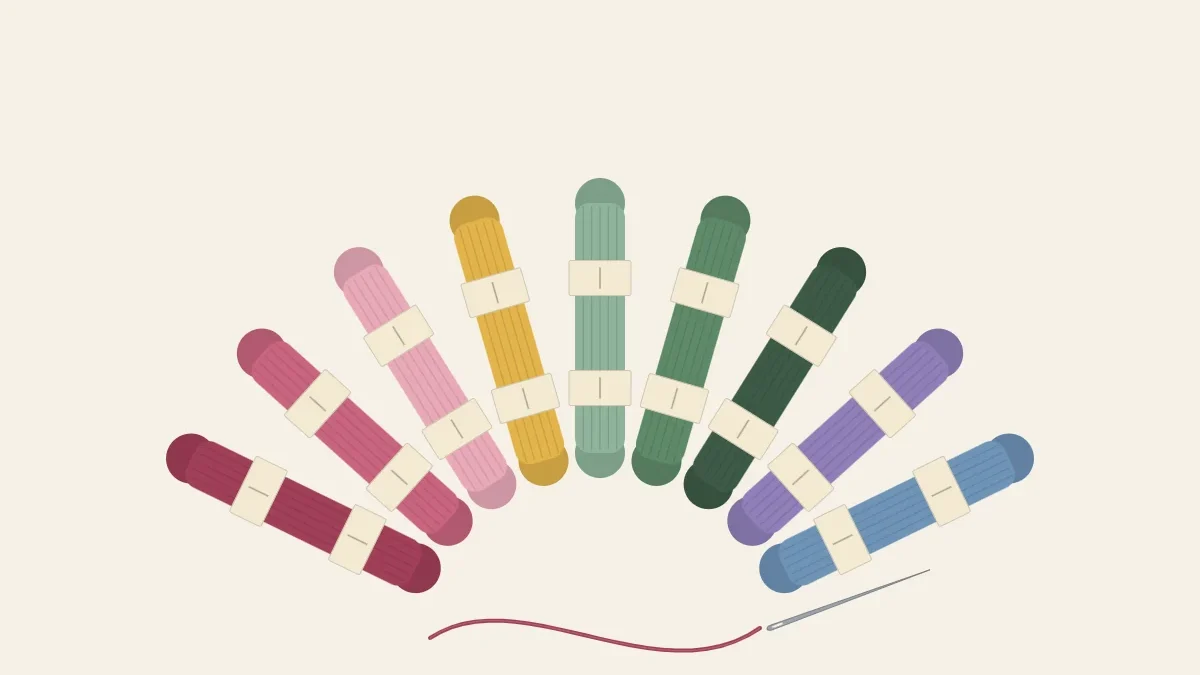
Six-strand cotton embroidery floss is the standard thread for stitched flowers because its thickness is adjustable. Each length is made of six fine strands twisted loosely together, and they are designed to be pulled apart and recombined. One strand draws a line as fine as a pencil mark; all six make a cord thick enough for a chunky rose.
Six-strand floss and perle cotton
The other cotton thread sold alongside floss is perle (pearl) cotton. It is a single, tightly twisted, glossy thread that cannot be divided, and it comes in sizes 3, 5, 8 and 12, where a higher number is finer.
| Six-strand floss | Perle cotton | |
|---|---|---|
| Structure | Six loose strands, divisible | One firm twisted thread, not divisible |
| Thickness | Set by the number of strands used | Set by the size bought |
| Best for | Filled petals, shading, fine detail | Raised, textured stitches and bold outlines |
Floss is the one to buy first, and every project on this site can be stitched with it. Perle cotton is a useful second thread for texture: a size 8 perle makes a line roughly as heavy as 3 strands of floss, and its round profile keeps the over-and-under pattern of a woven wheel rose crisp.
Separating strands without tangles
Trying to split a length into two groups and pull them apart is what causes knots, because the strands are twisted around each other along the whole length. Take them out one at a time instead.
- Cut one length. Measure about 18 inches (45 cm) from the skein and cut it cleanly.
- Pinch near one end. Hold the floss between thumb and forefinger about 1 inch (2.5 cm) from the top and tap the cut end so the six strands fan apart.
- Pull one strand straight up. Draw it out slowly with the other hand while the pinch stays loose. The remaining strands bunch up below your fingers, which is harmless.
- Smooth the rest. Run the bunched floss between two fingers and it falls straight again.
- Repeat, then recombine. Pull out as many strands as the stitch needs, lay them side by side with the ends level, and thread them together.
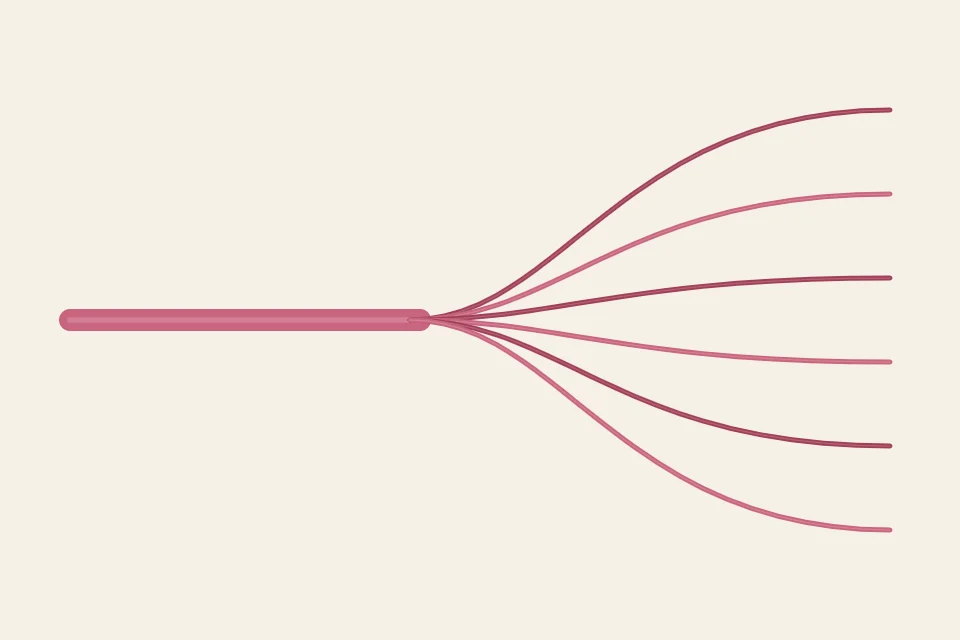
Separate the strands even when you plan to use all six. Strands that have been pulled apart and laid back together lie parallel instead of twisted, so they spread wider and cover the fabric more evenly.
How many strands to use
The number of strands sets the weight of the line and the scale of the stitch. The illustration shows one stitch worked with 1, 2, 3 and 6 strands.

| Strands | Effect | Typical uses | Embroidery needle |
|---|---|---|---|
| 1 | Hairline, delicate | Stamens, leaf veins, fine shading over other stitches | Size 9 or 10 |
| 2 | Light, neat | Thin stems, small petals, outlines in a 4-inch (10 cm) hoop | Size 7 or 8 |
| 3 | Medium, good coverage | Most petals, leaves and stems in a 6-inch (15 cm) hoop | Size 7 or 8 |
| 6 | Bold, raised | Chunky roses, thick branches, large textured centers | Size 5 |
Four strands sit between the last two rows and also take a size 5 needle. Individual stitches have their own preferences. Fewer strands give a smoother surface in satin stitch petals, and the size of a knot depends on strands as much as on wraps, as the guide to French knots shows. A line of stem stitch looks most rope-like with 3 strands or more.
Thread length: why 18 inches
Floss passes through the fabric once for every stitch, and each pass rubs it a little. By the end of a long length the thread is fuzzy and dull. About 18 inches (45 cm) is short enough to finish before that wear builds up, and short enough to pull through in one arm movement. Leave a tail of about 3 inches (8 cm) through the needle’s eye.
Stitching also adds twist. When the floss starts to kink or the strands separate into ridges, let the needle hang freely from the fabric for a few seconds and it will spin itself straight.
Tip
For an even number of strands, try a loop start. Cut a single strand 36 inches (90 cm) long, fold it in half and thread the two cut ends through the needle. Take the first stitch, then pass the needle through the loop on the back and pull snug. The thread is anchored with no knot.
Checking colorfastness
Most cotton floss is dyed to stay put, but strong reds, deep blues, purples and hand-dyed threads sometimes release color when wet. That matters because finished pieces are usually rinsed to remove pen lines. To check a suspect color, wet a short piece, lay it on a white paper towel, fold the towel over and press for a minute. Any tint on the towel means the thread bleeds.
A thread that bleeds can still be used. Rinse the cut lengths in cool water until the water runs clear, dry them flat and then stitch. When rinsing the finished embroidery, use cool running water, keep the piece moving, and never leave it folded on itself while damp.
Storing floss
- Keep the color number. Leave the paper bands on the skein, or write the number on whatever the floss is wound onto.
- Find the free end. One tail of a skein pulls out smoothly. If the skein starts to bunch into a knot, stop and try the other tail.
- Wind or bag. Card bobbins in a divided box keep colors visible; small labeled bags are quicker and leave no creases.
- Save leftover strands. Wrap spare strands around the bobbin of the same color.
- Protect from light and damp. A closed box in a dry room is enough.
Troubleshooting thread problems
- The floss knots on the back mid-stitch. It is usually a slip loop, not a true knot. Put the needle into the loop and pull gently on each side in turn until it opens. Shorter lengths and regular untwisting prevent it.
- The thread turns fuzzy. The length is too long or the needle too fine for the number of strands. Cut a fresh length and move up one needle size.
- Strands pull through unevenly, leaving one loose. The ends were not level when threaded. Align the ends next time.
- The floss shreds at the eye. Check the needle for a rough eye and replace it; needles are consumables.
Frequently asked questions
How much floss does one small flower project use?
Far less than a skein per color in most cases. A design in a 6-inch (15 cm) hoop stitched with 2 or 3 strands typically uses a few lengths of each color, so one skein covers several projects.
Can two different colors be threaded in the needle together?
Yes. Combining one strand of each of two close shades gives a soft blended color that is useful for shading petals and for natural-looking leaves.
Should the thread be knotted at the start?
A small knot is fine for pieces displayed in a hoop. For items that will be washed or worn, start with a few tiny stitches that later stitching covers, or use a loop start, so there is no lump on the back.
Is thread conditioner or beeswax needed for cotton floss?
No. Cotton floss at an 18-inch (45 cm) length behaves well without it, and wax can dull the sheen. Shorter lengths and regular untwisting solve most tangling.