Woven Wheel Stitch: How to Embroider a Woven Rose
The woven wheel stitch turns five spokes and one long thread into a raised rose. Here is how to space the spokes, weave over and under, and judge tension and size.
Tutorial at a glance
Materials
- Six-strand cotton embroidery floss in a rose color
- Embroidery needle size 7 for the spokes
- Embroidery needle size 5 for the weaving
- Blunt tapestry needle (optional)
- Water-soluble pen
- 6 in (15 cm) hoop
- Small embroidery scissors
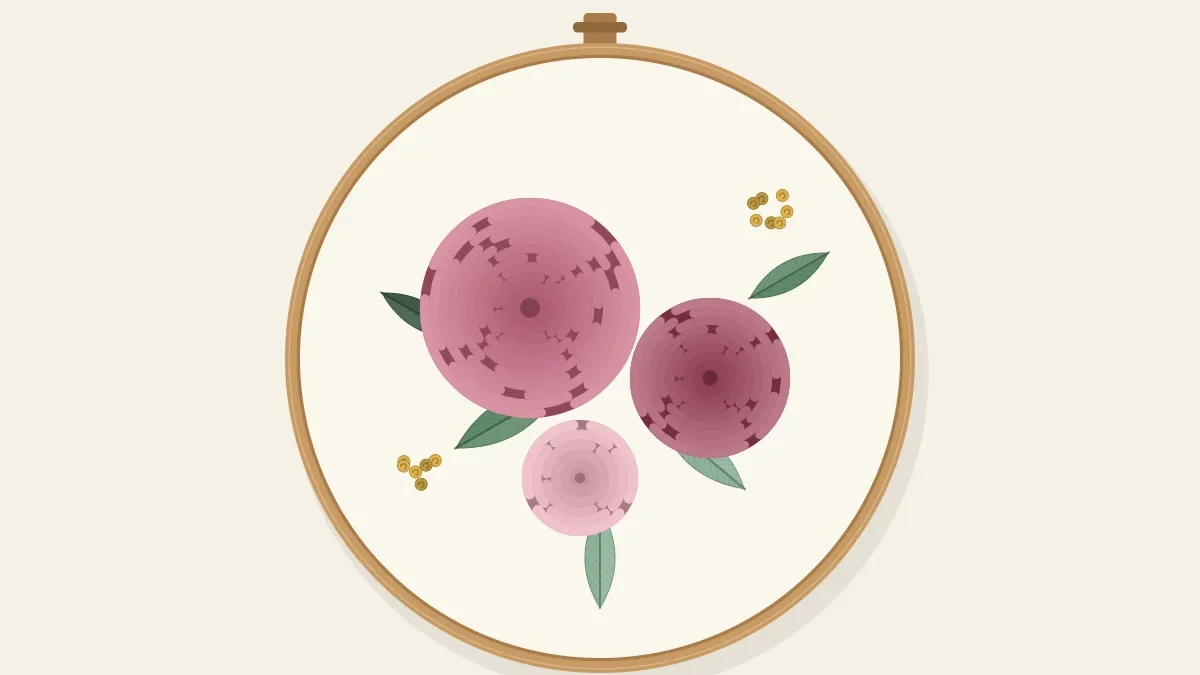
A woven wheel makes a rose without a single petal being stitched. Five straight stitches form the spokes of a wheel, and a thick thread is then woven around them, over one spoke and under the next, until the spokes vanish. Because the number of spokes is odd, the thread that passed over a spoke on one round passes under it on the following round. Each round therefore sits offset from the one beneath, and the stacked ridges look like overlapping petals. With an even number of spokes the thread would repeat the same path every round and nothing would build up.
Thread and Needles
The spokes and the weaving do different jobs, so they take different threads.
- Spokes: three strands of six-strand cotton embroidery floss in the rose color, on an embroidery needle size 7. They are hidden in the end, but a matching color means a thin spot will not show.
- Weaving: all six strands, on a size 5 needle. A fat, soft thread fills the wheel in fewer rounds and gives rounder petals.
- Optional: a blunt tapestry needle for the weaving. If you only have the sharp needle, pass it under the spokes eye first so it cannot split them.
This is one of the few places to cut longer than the usual 18 inches (45 cm). Joining a new thread halfway through the weaving is awkward, so start with about 30 inches (75 cm) for a 3/4-inch wheel. Perle cotton also weaves well; the thread guide compares it with stranded floss.
Draw the Circle and Stitch Five Spokes
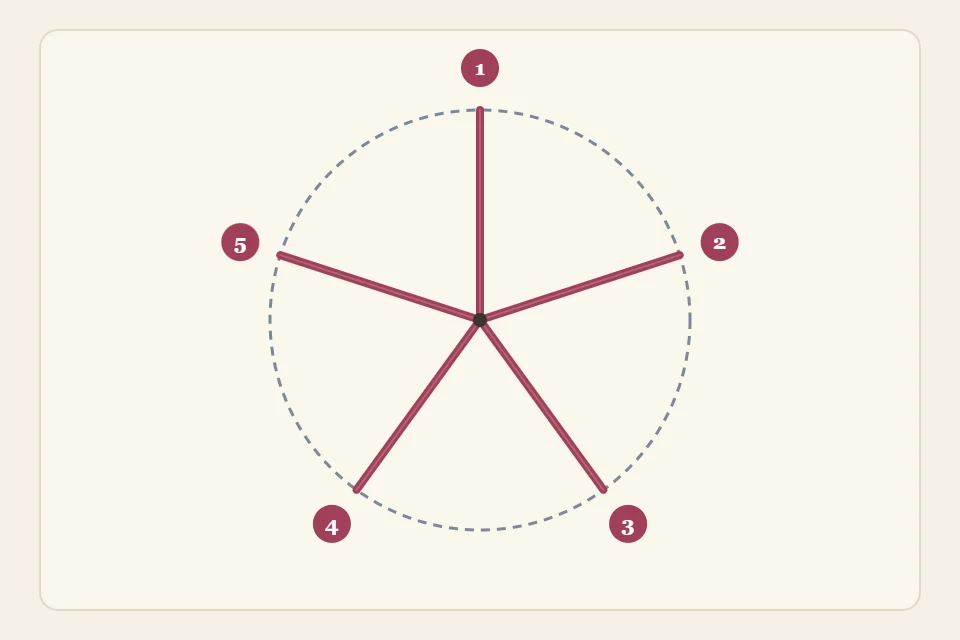
With a water-soluble pen, draw a circle 3/4 inch (2 cm) across and put a dot at its center. Mark five points on the circle, evenly spaced like the points of a star: one at the top, two a little below the middle on either side, and two at the bottom. The diagram numbers them 1 to 5 going around the circle.
- Stitch spoke 1. With three strands, bring the needle up at point 1 on the circle and take it down through the center dot.
- Add spokes 2 to 5. Come up at each numbered point in turn and go down into the same center hole every time, so all five meet at one spot.
- Check the tension. Each spoke should lie flat and firm, neither sagging nor pulling a dimple into the fabric.
- Fasten off on the back. Run the thread under the stitches behind the wheel and trim it.
Weave Over and Under
- Come up at the center. Thread all six strands, knot the end, and bring the needle up between spokes 1 and 2, as close to the center as you can.
- Start the pattern. Pass the needle over spoke 2 and under spoke 3, over 4 and under 5. The needle slides between the spoke and the fabric; it does not go through the fabric at all.
- Keep going around. Continue over spoke 1, under 2, over 3. The pattern has now reversed by itself, which is the odd number doing its work.
- Pull the first two rounds snug. This closes the center so the hole where the spokes meet is hidden.
- Relax as the wheel grows. From the third round on, let the thread rest against the previous round without tugging. Turn the hoop as you go so you are always weaving toward yourself.
- Finish at the edge. When the ends of the spokes are covered, take the needle down just under the last round, beside a spoke, and fasten off on the back.

How Tight and How Many Rounds
Tension decides what the rose looks like. Pulled hard all the way out, the weaving shrinks into a small, hard button and the spokes show at the rim. Left too slack, the rounds stand up as loops that catch on things. Aim for thread that lies like a ribbon: flat, untwisted and just touching the round before it. Letting the needle dangle now and then takes out the twist that builds up as you circle.
There is no fixed number of rounds, because it depends on the thread and on your tension. As a rough guide, a 3/4-inch (2 cm) wheel in six strands fills in about eight to ten rounds. Stop when the spoke ends are hidden and another round would have to sit on top of the last one instead of beside it. If there is room left but the weaving looks crowded, push the earlier rounds toward the center with the needle tip and fit one more in.
Size Limits and Thread Choices
| Circle | Spokes | Weaving thread | Notes |
|---|---|---|---|
| 3/8 inch (1 cm) | 5, in two strands | Three strands | A bud-sized rose; four or five rounds |
| 1/2 to 3/4 inch (12 mm to 2 cm) | 5, in three strands | Six strands | The most forgiving size to learn on |
| 1 inch (2.5 cm) | 5, in three strands | Six strands, cut 40 inches (1 m) | Keep outer rounds neat; long loops snag |
| Over 1 1/4 inches (3 cm) | 7 | Six strands or perle cotton | Best kept for wall pieces |
Large wheels have long outer loops held down only at the spokes, so they are a poor choice for clothing or anything washed often. For a big rose that lies flat against the fabric, a stem stitch rose is worked as a spiral with no spokes, and a bullion knot rose gives a tight, small bloom.
Tip
For a shaded rose, weave the first three or four rounds in a darker shade, fasten off under the wheel, and finish the outer rounds in a lighter one.
Troubleshooting
- The pattern stops alternating. A spoke was skipped, or two were passed in one go. Unweave back to the mistake; the thread simply pulls out.
- Spokes show at the outer edge. Either the weaving is too tight or the wheel needs more rounds. Loosen the last round with the needle and add another.
- The needle keeps splitting a spoke. Weave eye first, or switch to a blunt tapestry needle.
- The thread runs out early. Take it down under the last round and fasten off. Bring the new length up in the same place and carry on in the same direction.
- The rose is lopsided. The spokes were unevenly spaced. Rounds can be nudged with the needle to disguise a small error; a large one needs new spokes.
Frequently asked questions
Can I make a woven wheel with six spokes?
No. With an even number the thread goes over and under the same spokes on every round, so it never covers them. Use five or seven.
Which direction should I weave?
Either clockwise or counterclockwise works. Pick the one that feels natural for your hand and keep to it for the whole rose.
Will a woven wheel rose survive washing?
Small, firmly woven roses hold up to gentle hand washing. Larger ones have loose outer loops that can snag or shift, so they are better on pieces that are displayed.
Can I use a different thread for the weaving?
Yes. Perle cotton, narrow silk ribbon and fine wool all weave well, and each gives a different petal texture over the same five spokes.