Easy Embroidered Sunflower With a French Knot Center
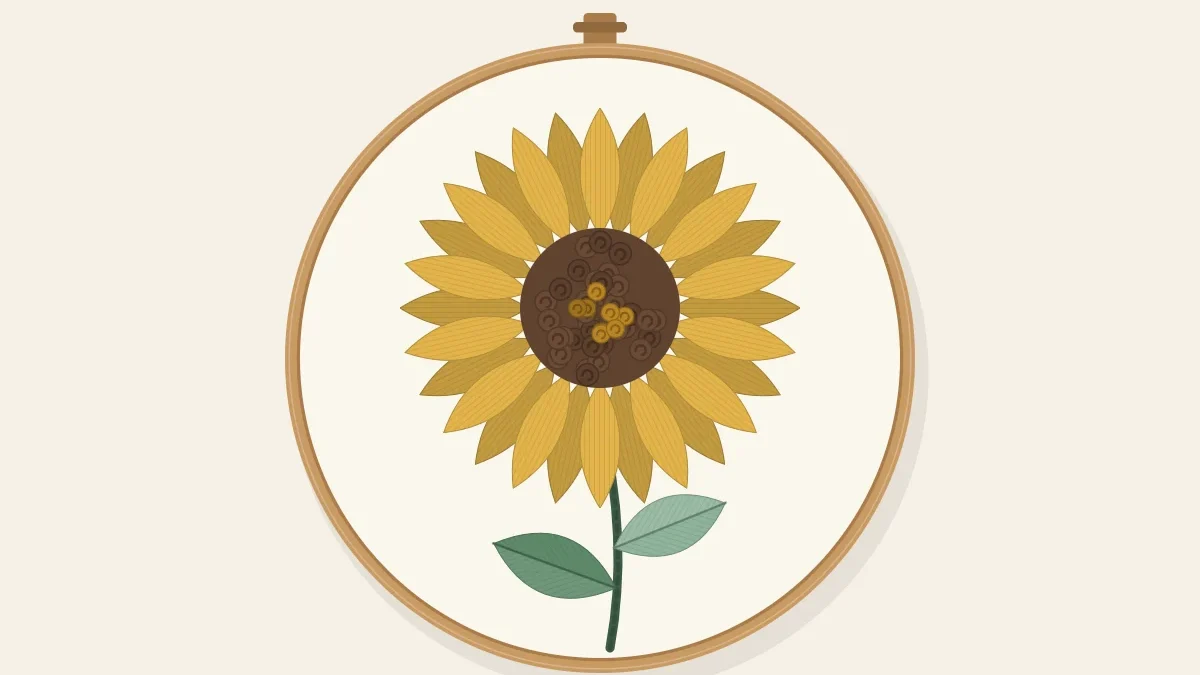
A single large sunflower with two offset rings of straight-stitch petals, a center packed with French knots, a thick stem and heart-shaped leaves, drawn from simple measurements.
Tutorial at a glance
Materials
- Six-strand cotton embroidery floss in golden yellow and a deeper gold
- Six-strand cotton embroidery floss in dark brown, plus optional mid brown
- Six-strand cotton embroidery floss in medium green
- Embroidery needle size 7
- 6-inch (15 cm) embroidery hoop
- 9-inch (23 cm) square of fabric
- Water-soluble pen and a ruler
- Small embroidery scissors
A sunflower is mostly texture: a wide, seedy center ringed by two layers of pointed petals. In thread, the center becomes a disc packed with French knots, and the petals become small fans of straight stitches worked in two rings, the second set into the gaps of the first. Nothing here is harder than a straight stitch and a knot, but the flower is large enough to fill a 6-inch (15 cm) hoop by itself.
Materials and thread plan
Use a medium-weight, non-stretch cotton or cotton-linen blend, cut about 9 inches (23 cm) square. The center holds a lot of knots, so the fabric has to be tight in the hoop and firm enough to carry the weight.
| Part | Floss color | Strands | Stitch |
|---|---|---|---|
| First petal ring | Golden yellow | 3 | Straight stitch fans |
| Second petal ring | Deeper gold or light orange | 3 | Straight stitch fans |
| Center | Dark brown, optional mid brown | 3 | French knots, two wraps |
| Stem | Medium green | 3 | Stem stitch, three rows |
| Leaves | Medium green | 2 | Slanted satin stitch |
Work with six-strand cotton embroidery floss cut to about 18 inches (45 cm) and an embroidery needle size 7.
Drawing the sunflower
Mark the center of the fabric with a dot and test the water-soluble pen on a scrap. Then draw:
- The center disc. A circle 1 inch (2.5 cm) across, with its middle 3/4 inch (2 cm) above the center dot. A large coin or a thread spool makes a handy template.
- First-ring guides. Twelve lines, each 5/8 inch (16 mm) long, radiating from the edge of the circle like clock hours. Mark 12, 3, 6 and 9 first, then two between each.
- Second-ring guides. Twelve more lines halfway between the first set. Start each one 1/4 inch (6 mm) out from the circle and end it 3/4 inch (2 cm) out, so these tips reach slightly beyond the first ring.
- The stem. From the bottom of the flower, a line 1 3/4 inches (4.5 cm) long, curving very slightly to one side.
- Two leaves. Heart shapes about 3/4 inch (2 cm) wide and 3/4 inch (2 cm) long, each joined to the stem by a 1/4-inch (6 mm) stalk at the notch of the heart. Place one on the left about 5/8 inch (16 mm) below the flower and one on the right about 1 1/8 inches (2.9 cm) below it, with the points aimed outward and a little downward. Draw a center line in each from notch to point.
The finished flower is about 2 1/2 inches (6.4 cm) across.
Stitching the flower head
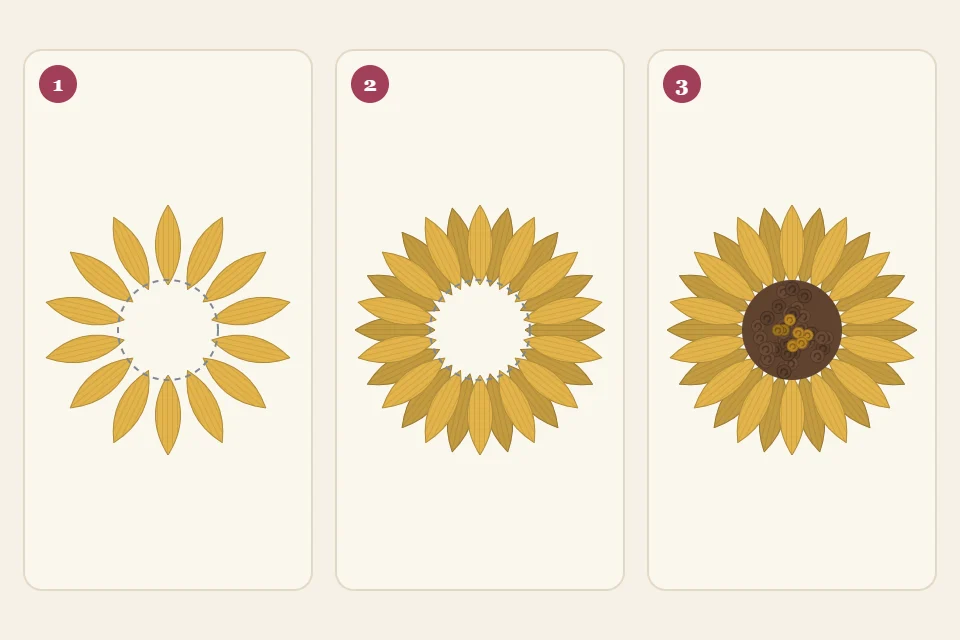
Follow the three numbered stages in the diagram. Petals come before the center so the knots can cover their inner ends.
- Stitch the first ring of petals. With three strands of golden yellow, bring the needle up at the outer tip of a guide line and take it down at the edge of the circle. Make a second stitch from the same tip hole down to the circle edge about 1/16 inch (1.5 mm) to the left of the first, and a third the same distance to the right. Three stitches sharing one tip make a pointed petal roughly 1/8 inch (3 mm) wide at its base. Work the four quarter petals first, then the eight between them.
- Add the second ring, offset between them. Switch to the deeper gold. On each second-ring guide, come up at the outer tip and go down at the inner end of the line, in the gap between two first-ring petals. Add one stitch on each side from the same tip, landing close beside the first. These petals appear to peek out from behind the first ring, and the color change adds depth.
- Fill the center with knots. With three strands of dark brown, work French knots with two wraps each. Begin with a ring of knots just inside the drawn circle, sitting over the inner ends of the petals, then work inward in a spiral until no fabric shows. Hold the thread taut while the needle goes down beside, not into, the hole it came up through. The method and its common failures are covered in the French knots tutorial.
A 1-inch center takes somewhere around 50 to 70 three-strand knots, depending on how firmly each is pulled. For a more lifelike disc, fill the outer two thirds in dark brown and the middle in a mid brown or olive.
A sturdy stem and heart-shaped leaves
A sunflower stalk is thick, so one line of stitching looks weak under such a heavy head. With three strands of green, work a row of stem stitch from the bottom of the drawn line up to the petals, keeping the working thread on the same side of the needle throughout. Add a second row tight against it on one side and a third on the other. Together they make a stem about 1/8 inch (3 mm) wide. Work each leaf stalk as a single row.
Fill each leaf in two halves with two strands. Start at the point of the heart and stitch one half in slanted satin stitch, from the outer edge down to the center line at about 45 degrees, working toward the rounded lobe at the notch. Repeat on the other half as a mirror image, so the stitches meet along the center in a row of shallow V shapes. The longest stitches are about 3/8 inch (10 mm). The meeting line serves as the vein. For a plaited vein instead, fill the leaf with fishbone stitch as described in the guide to fishbone stitch leaves.
Troubleshooting
- Gaps between petals near the center. Widen the base of each fan by moving the two side stitches a little further apart, or add a fourth stitch.
- The second ring disappears. The two yellows are too similar or the tips are too short. Choose a clearly deeper gold and make sure the tips reach 3/4 inch (2 cm) from the circle.
- Petals look limp or loopy. Stitches of this length need gentle, even tension and a tight hoop. Retighten and re-lay any that sag.
- Knots are different sizes. Keep to two wraps on every knot and hold the thread taut until the last moment.
Finishing
Rinse out the pen marks in cool water, dry the piece flat and press it face down on a thick folded towel so the knots keep their height. For mounting, see how to finish an embroidery hoop.
Frequently asked questions
How much brown floss does the center need?
French knots use more thread than they appear to. One full skein is more than enough for a 1-inch center, but plan on rethreading four or five 18-inch lengths of three strands.
Can I fill the center with something faster than French knots?
Yes. A grid of small crossed straight stitches or rows of tiny seed stitches fills the disc more quickly, though it sits flatter. A ring of knots around the edge with seed stitch inside is a good compromise.
Should the petals be satin stitched instead?
They can be, but fans of straight stitches are quicker and look suitably loose for a sunflower. Satin stitch gives a smoother, more formal petal and works best if each petal is drawn as a full outline first.
Can I make a smaller sunflower?
Halve every measurement and use two strands throughout. With a 1/2-inch center, eight petals per ring are enough, and each petal can be two stitches rather than three.