Best Fabric for Embroidery: Cotton, Linen and Blends Explained
Medium-weight woven cotton, linen and cotton-linen blends make the most reliable ground for hand embroidery. This guide covers weave, weight, prewashing, ground color and how big to cut.

Tutorial at a glance
The fabric under an embroidered flower is called the ground, and it does more than sit in the background. It has to hold the weight of the stitches without sagging, let a needle pass through without a fight, stay the same shape in and out of the hoop, and survive a rinse at the end. Plain woven cotton, linen and blends of the two do all four. Most other fabrics fail at least one.
Cotton, linen and blends compared
| Fabric | Surface | Strengths | Drawbacks |
|---|---|---|---|
| Plain woven cotton | Smooth and even | Inexpensive, easy to trace on, crisp stitch edges, many colors | Thin versions let thread on the back show through |
| Linen | Textured, with thick and thin threads | Strong, holds heavy stitching, attractive natural look | Creases easily, costs more, uneven threads can nudge stitches off line |
| Cotton-linen blend | Lightly textured | Linen’s body with cotton’s evenness; a forgiving all-rounder | Fewer colors to choose from |
For a first project, a medium-weight cotton or cotton-linen blend is the safest choice. Cotton sold for quilting is a good benchmark: firm, opaque and smooth. Pure linen suits loose, natural designs such as wildflowers once your tension is steady.
Weave: what to look for up close
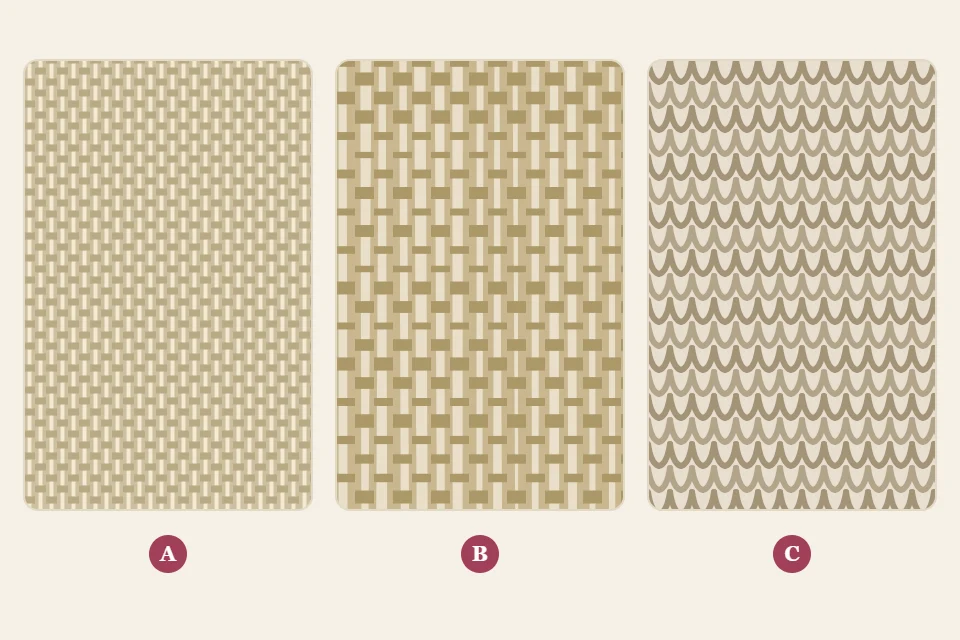
Hold the fabric near a window and look at how the threads are put together. Three structures cover almost everything in a fabric store.
- A: tight plain weave. Threads cross over and under one at a time in a close, regular grid. This is typical of cotton. The needle can go in almost anywhere, so curves and small petals come out smooth.
- B: looser, slubby weave. The same over-and-under pattern, but with more space between threads and occasional thick lumps called slubs. This is typical of linen. It stitches well, though a needle that lands beside a slub may slide to one side of it.
- C: knit loops. Rows of interlocking loops with no straight grid at all. This is stretch jersey, the fabric of T-shirts, and the loops are what let it stretch.
Density matters as much as structure. A weave that is too tight, such as canvas, denim or high-thread-count sheeting, grips the needle and wears the thread at every pass. A weave that is too open, such as cheesecloth or burlap, gives short stitches nothing to hold on to, so outlines turn jagged. A quick test: push a size 7 embroidery needle through a corner. It should pass with light pressure and leave no visible hole.
Weight: firm enough to carry stitches
Weight is how heavy the cloth is for its area. Medium weight for embroidery means roughly 4 to 6 ounces per square yard (about 135 to 200 grams per square meter), which is the range of quilting cotton and shirt-weight linen. Without a scale, judge it by hand:
- Laid over a printed page, the fabric should blur the text. If the words stay readable, thread carried across the back will show on the front as a shadow.
- Draped over a finger, it should fall in soft folds, not stand stiffly and not collapse like a scarf.
- Pulled gently between two hands along the grain, it should not give.
Fabric that is slightly too thin can still be used by hooping a second layer of plain white cotton behind it and stitching through both as one.
Why stretch fabric can wait
Knit fabric lengthens when the hoop pulls it taut. Stitches are then worked on cloth that is larger than its relaxed size, and the thread itself does not stretch. When the hoop comes off, the knit springs back, the stitching does not, and the fabric gathers into puckers around every flower. Embroidering on T-shirts is possible with a stabilizer on the back, but that is a separate skill. Avoid woven fabrics with added elastic fiber for the same reason; the label will list spandex or elastane.
Prewashing and pressing
Cotton and linen both shrink the first time they get wet, and most marking pens are removed by rinsing. If the first soak happens after the stitching, the ground shrinks while the floss stays the same length, and smooth work turns bumpy. Prewashing moves that shrinkage to the start. It also removes sizing, the finish that stiffens new fabric.
- Wash. Use warm water and a little mild soap, by hand or on a gentle machine cycle. Wash dark colors separately and rinse until the water runs clear.
- Dry until just damp. Hang it up or lay it flat. Do not wring linen hard, as sharp creases are stubborn.
- Press. Iron while slightly damp, moving along the straight grain, until it is flat and dry. Test the heat on a corner first.
Choosing a ground color
White, ivory and natural oatmeal are the easiest to start on. Nearly every thread color shows clearly against them, and they are pale enough for tracing against a window. Dark grounds need a different approach, explained in how to transfer embroidery designs.
Mid-tone solids such as sage green, dusty blue or soft gray solve a specific problem: white and cream flowers vanish on white cloth but stand out on color. Navy, charcoal and black make pale thread glow, yet the ground can peek between stitches, so petals may need 3 strands of floss where 2 would do on white. Because the ground sits next to every thread in the design, treat it as one of the palette colors; choosing colors for floral embroidery covers how thread and fabric shift each other.
How big to cut the fabric
Measure the hoop’s diameter and add 2 inches (5 cm) on every side. The margin gives the rings something to grip and room to pull the fabric taut.
| Hoop size | Cut the fabric |
|---|---|
| 4 inch (10 cm) | 8 inches (20 cm) square |
| 6 inch (15 cm) | 10 inches (25 cm) square |
| 8 inch (20 cm) | 12 inches (30 cm) square |
Cut along the grain, following a single woven thread, so the square is true and the fabric tensions evenly in the hoop. Loosely woven linen frays as it is handled; trim the edges with pinking shears or sew a quick line of running stitch 1/4 inch (6 mm) inside each edge. Leave the margin untrimmed until the stitching is finished, since it is needed when finishing the back of the hoop.
Tip
Keep the offcuts of a project fabric for testing a marking pen, an iron setting or a thread color.
Frequently asked questions
Can I embroider on an old cotton sheet or pillowcase?
Often, yes. Well-washed plain cotton is soft and already shrunk, which helps. Very high thread counts grip the needle, and worn-thin areas may not support stitches, so test a corner first.
Is Aida cloth suitable for embroidered flowers?
Aida is woven in a grid of holes for counted cross stitch. Freehand flower stitches need to land between those holes, which is awkward, so a plain weave is a better choice.
Is muslin good for embroidery practice?
Unbleached cotton muslin is cheap and pleasant to stitch, which makes it fine for practice. It is usually thin, so use two layers together if thread on the back shows through.
Should the fabric be ironed with steam before stitching?
Steam or a light mist of water helps flatten cotton and linen. Let the fabric dry completely before drawing on it, because damp cloth makes water-soluble pen lines spread.