
The Ultimate Backdoor Roth IRA Guide
The High Earner’s Path to Tax-Free Retirement Savings
This backdoor Roth IRA guide is for anyone who earns too much to contribute directly to a Roth IRA but still wants tax-free growth in retirement.
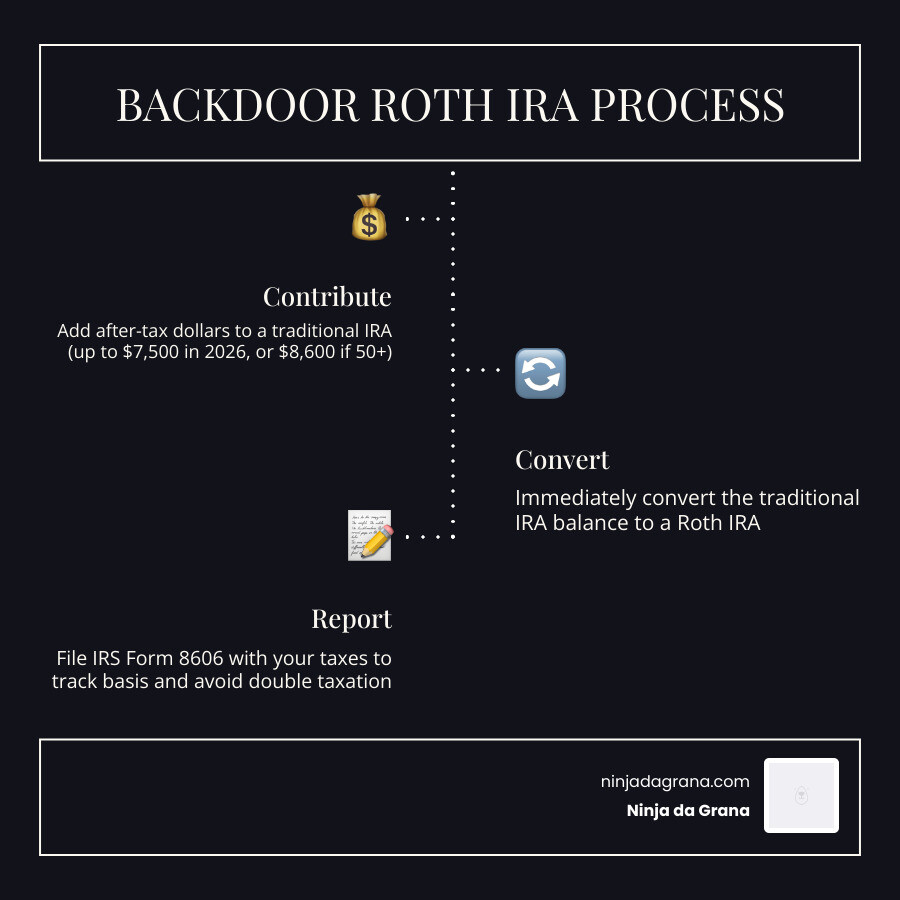
Here’s the backdoor Roth IRA process at a glance:
- Contribute after-tax dollars to a traditional IRA (up to $7,500 in 2026, or $8,600 if age 50+)
- Convert that traditional IRA balance to a Roth IRA
- Report the transaction on IRS Form 8606 when you file your taxes
- Repeat each year as long as you have earned income
In 2026, single filers earning $168,000 or more — and married couples earning $252,000 or more — are completely blocked from making direct Roth IRA contributions. The backdoor method is the legal workaround.
This strategy isn’t a loophole or a gray area. It combines two long-standing IRS rules: nondeductible traditional IRA contributions and Roth conversions. When done correctly, the tax bill on the conversion is zero — and your money grows tax-free from there.
The catch? A few rules can trip you up — especially if you already have pre-tax IRA money sitting around. We’ll cover all of that below.
What is a Backdoor Roth IRA?

Despite the name, a “Backdoor Roth IRA” isn’t a specific type of account you open at a bank. Instead, it is a financial strategy — a two-step dance that allows high earners to bypass the income limits that usually keep them out of the Roth club.
In the simplest terms, we are making a nondeductible contribution to a Traditional IRA and then immediately performing a Roth conversion. Because the money you put into the Traditional IRA was already taxed (after-tax dollars), and you didn’t take a tax deduction for it, converting it to a Roth IRA shouldn’t trigger a new tax bill, provided you follow the rules we’ll discuss later.
Who Should Use This Backdoor Roth IRA Guide?
We designed this backdoor Roth IRA guide specifically for “high earners.” But what does that actually mean in the eyes of the IRS? For the 2026 tax year, if your Modified Adjusted Gross Income (MAGI) exceeds certain thresholds, you are ineligible to put a single cent directly into a Roth IRA.
You should consider the backdoor strategy if:
- You are a single filer with a MAGI over $168,000.
- You are married filing jointly with a MAGI over $252,000.
- You want the benefits of tax-free growth and tax-free withdrawals in retirement.
- You want to avoid Required Minimum Distributions (RMDs), which Roth IRAs do not have during the owner’s lifetime.
Why Direct Contributions are Restricted
The IRS limits Roth IRA participation because the tax benefits are so powerful. By allowing your investments to grow completely tax-free for decades, the government loses out on future tax revenue. To “fairly” distribute this benefit, they phase out eligibility as your income rises.
For 2026, the phase-out ranges are narrow. If you fall within these ranges, you can only make a partial contribution. If you’re above them, the “front door” is locked.
| Filing Status | 2025 Full Contribution Limit (MAGI) | 2026 Full Contribution Limit (MAGI) |
|---|---|---|
| Single / Head of Household | < $150,000 | < $153,000 |
| Married Filing Jointly | < $236,000 | < $242,000 |
| Married Filing Separately | $0 (Phase-out starts at $0) | $0 (Phase-out starts at $0) |
Note: In 2026, the ability to contribute anything at all disappears at $168,000 for singles and $252,000 for couples.
Step-by-Step Backdoor Roth IRA Guide

Executing this strategy is like following a recipe. If you skip a step or mix the ingredients in the wrong order, you might end up with a tax headache. Here is our refined Backdoor Roth IRA Setup: Your Detailed Guide to help you get it right.
Funding Your Traditional IRA
The first step is to open a Traditional IRA if you don’t already have one. You then make a nondeductible contribution. For 2026, that limit is $7,500 (or $8,600 if you’re 50 or older).
Pro-Tip: When you deposit this money, keep it in a “settlement fund” or a “money market fund” (essentially cash). You don’t want to invest it in stocks just yet. If the $7,500 grows to $7,550 before you convert it, that $50 gain will be taxable. Keeping it in cash for a few days ensures the balance stays stable for a clean conversion.
Executing the Conversion
Once the funds have “settled” in your Traditional IRA (usually 24 to 72 hours), you log into your brokerage account and choose the option to “Convert to Roth.” You will move the entire balance from your Traditional IRA into your Roth IRA.
Most major brokers like Vanguard, Fidelity, and Schwab have a simple button for this. They will display a scary-looking warning that says, “This may be a taxable event!” Don’t panic. Since you are converting after-tax dollars that weren’t deducted, the taxable portion of this specific transaction should be zero (assuming you have no other IRA balances).
Navigating the Pro-Rata Rule and Tax Implications
This is where many people get tripped up. The IRS doesn’t look at your IRAs individually; they look at them as one giant bucket. This is known as the Aggregation Rule.
If you have $92,500 in a “Rollover IRA” from an old job (which is pre-tax money) and you add $7,500 of after-tax money to a new Traditional IRA to do a backdoor conversion, the IRS sees you have $100,000 total. If you convert $7,500, they will say that 92.5% of that conversion is taxable because 92.5% of your total IRA holdings are pre-tax. This is the “Pro-Rata Rule.”
For a deeper dive into these complexities, check out The Backdoor Roth Contribution: A Complete Guide for High Earners.
The December 31st Aggregation Rule
The IRS checks your “pre-tax balance” on December 31st of the year you do the conversion. This means if you do a conversion in February, you must make sure any other Traditional, SEP, or SIMPLE IRAs are empty by the end of the year.
The good news? 401(k)s, 403(b)s, and 457 plans do NOT count toward the pro-rata rule. If you have a large Traditional IRA balance, you can often “roll it backward” into your current employer’s 401(k) to clear your path for a tax-free backdoor Roth conversion.
Tax Reporting for Your Backdoor Roth IRA Guide
You must tell the IRS what you did, or they will assume you owe taxes on the whole conversion. The key is IRS Form 8606.
- Part I tracks your “basis” (the nondeductible money you put in).
- Part II tracks the conversion itself.
When you file your 2026 taxes, you’ll also receive a Form 1099-R from your broker, which reports the distribution from the Traditional IRA. Using modern tax software makes this much easier, but you must be careful to select that you made a nondeductible contribution.
Advanced Strategies and Common Pitfalls
While the standard backdoor Roth is great, there are even more powerful ways to save. However, with more power comes more complexity.
Avoiding Pitfalls in Your Backdoor Roth IRA Guide
- The Pro-Rata Trap: As mentioned, having any balance in a SEP-IRA, SIMPLE IRA, or Traditional IRA on Dec 31st will trigger taxes.
- Waiting Too Long: If you leave the money in the Traditional IRA for months and it earns interest, you’ll have to pay taxes on those earnings during the conversion.
- No Earned Income: You (or your spouse) must have “earned income” (wages/salary) to contribute. Investment income or Social Security doesn’t count.
- The 5-Year Rule: Every conversion has its own 5-year clock. You generally cannot withdraw the converted amount penalty-free until five years have passed, even if you are over age 59½.
The Mega Backdoor Roth Alternative
If your employer’s 401(k) plan allows for “after-tax contributions” (which are different from Roth 401k contributions) and “in-plan conversions,” you might be able to do a Mega Backdoor Roth.
In 2026, the total 401(k) limit (including employer match) is up to $72,000. This strategy allows some people to funnel an extra $30,000 to $40,000 per year into a Roth account. It’s the “supercharged” version of the strategy we’ve been discussing.
Frequently Asked Questions about Backdoor Roth IRAs
Can I do a backdoor Roth IRA every year?
Yes! As long as you have earned income and your MAGI is above the limits for direct contributions, you can (and likely should) do this annually. Many high-income professionals make this a part of their “financial New Year” routine every January. Just remember that the contribution deadline is April 15th of the following year, but the conversion is reported in the calendar year it actually happens.
How does the 5-year rule apply to conversions?
This is a common source of confusion. There are actually multiple 5-year rules. For backdoor Roths, the most important one is that each conversion has its own 5-year waiting period before you can withdraw the principal penalty-free. If you are under 59½ and you withdraw converted funds before that 5-year window closes, you may face a 10% penalty. However, once you are over 59½ and have had a Roth IRA open for at least five years, most withdrawals are entirely tax-and-penalty-free.
What if I have existing traditional IRA balances?
If you have a Rollover IRA or a Traditional IRA with pre-tax money, you have three main options:
- Convert it all: This will trigger a large tax bill now, but everything will grow tax-free forever.
- Roll it into a 401(k): If your employer plan allows “reverse rollovers,” you can move the pre-tax IRA money into the 401(k). Since 401(k)s are ignored by the pro-rata rule, this “cleans” your IRA slate for future backdoor conversions.
- Pay the Pro-Rata tax: You can proceed with the backdoor, but you’ll owe taxes on a portion of the conversion every year.
Conclusion
Mastering the backdoor Roth IRA is a milestone in any high earner’s financial journey. It represents a move from basic saving to strategic wealth building. By following this backdoor Roth IRA guide, you are ensuring that a larger portion of your hard-earned money stays in your pocket during retirement rather than going to the IRS.
At Ninja da Grana, we believe that financial organization is the foundation of freedom. Whether you are navigating complex tax rules or just trying to get your monthly budget in order, having a goal-oriented plan is what separates the dreamers from the achievers.
Tax diversification — having money in taxable, tax-deferred, and tax-free accounts — gives you incredible flexibility in retirement. The backdoor Roth is one of the best tools to achieve that balance.
Ready to take control of your financial future? Start your financial journey with Ninja da Grana today and discover the tools, resources, and tips you need to master your money.
